
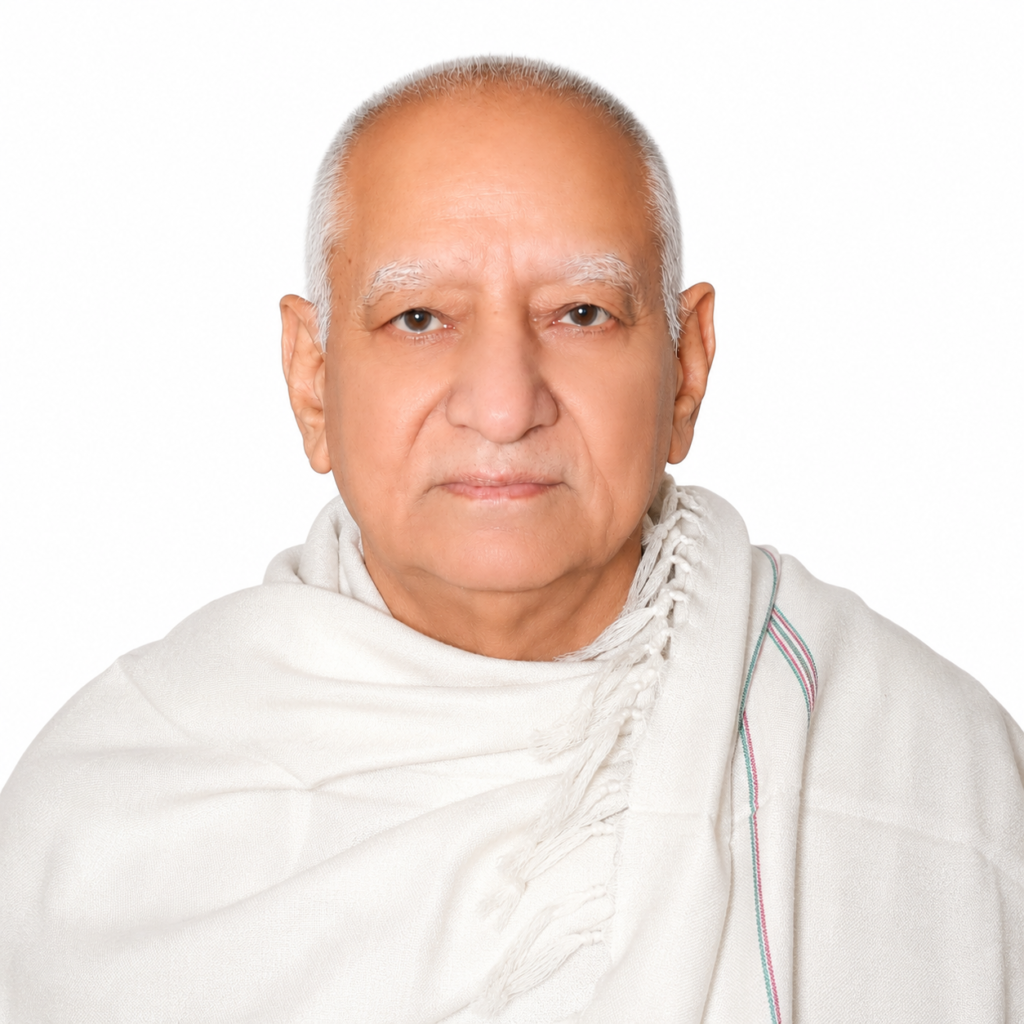
Late Shri Babu Ram Chawla
(1931–2011)
Late Shri Babu Ram Chawla lived a life that quietly reflected the very principles taught throughout the Yoga School of Bharat. From witnessing the Partition of India in 1947 and rebuilding life from nothing, to raising a family, guiding a community, and dedicating decades to the study of Yoga, spirituality, Ayurveda, and self-inquiry, his journey was one of resilience, service, and inner transformation. Through his wisdom, compassion, and example, he inspired countless individuals to live with greater awareness, simplicity, and purpose. His life remains a lasting source of inspiration and continues to guide the vision of this school.
A Life of Courage, Service, and Self-Discovery
Born in 1931, Late Shri Babu Ram Chawla lived through one of the most defining periods in India’s history. As a young man, he witnessed the Partition of India in 1947, an event that displaced millions of families and forever changed countless lives. Like many others of his generation, he left behind everything familiar and arrived in Gwalior to begin life again with little more than determination, faith, and the willingness to work hard.
Starting from nothing, he rebuilt his life through perseverance, honesty, and unwavering commitment to his responsibilities. Alongside managing two businesses, he raised three children with the values of discipline, integrity, compassion, and self-reliance. He believed that true success was never measured by wealth or social status, but by one’s character, one’s contribution to society, and the ability to stand on one’s own feet while helping others do the same.
As his worldly responsibilities became established, his attention naturally turned toward the deeper questions of human existence. He developed an intense curiosity about the purpose of life, the nature of the mind, and the possibility of inner freedom. This sincere search led him to study the Bhagavad Gita, the Upanishads, the Vedas, Yoga, Vedanta, and many other spiritual scriptures. Yet he remained convinced that wisdom could never be gained through reading alone. Knowledge had to be reflected upon, experienced, and lived in everyday life.
His longing for truth inspired him to seek the guidance of enlightened teachers. Although he learned from many sources, he ultimately realised that the deepest transformation arises through sincere self-inquiry, disciplined practice, and direct experience. Rather than speaking about spirituality as an abstract philosophy, he quietly allowed his own life to become an expression of the values he had discovered. His humility, simplicity, equanimity, and compassionate nature reflected a life rooted in awareness rather than ego.
For nearly two decades, he conducted regular Yoga and philosophy sessions for people from all walks of life. His teachings extended far beyond physical postures. He explained Yoga as a complete science of living—one that cultivates self-awareness, ethical conduct, emotional balance, and conscious action. Complex philosophical concepts were presented in simple, practical language, enabling ordinary people to understand and apply them in their daily lives.
Those who spent time with him often discovered that his greatest teachings came not only through formal sessions but through everyday conversations and the example he set by the way he lived. He encouraged people to question, observe, and verify spiritual principles through their own experience rather than accepting them blindly. To him, spirituality was not something reserved for temples or scriptures; it was reflected in honesty, patience, kindness, humility, responsibility, and the ability to remain balanced through both joy and hardship.
Over the years, many individuals approached him seeking guidance during difficult periods of their lives. Whether they were struggling with emotional challenges, family conflicts, anxiety, grief, or questions about life’s purpose, he patiently listened without judgement and offered thoughtful guidance rooted in wisdom, compassion, and practical understanding. His calm presence, gentle words, and ability to simplify life’s complexities made him a trusted mentor for countless people.
Alongside his spiritual work, he devoted himself to the study of Ayurveda and natural healing. Through years of personal research and experimentation, he prepared a variety of herbal remedies using natural and organic ingredients available around him. These preparations brought relief to many people suffering from common ailments. For him, healing was never a profession or a means of recognition; it was simply another expression of selfless service. His desire was always to reduce suffering wherever he could, whether through knowledge, counsel, or natural medicine.
Perhaps his greatest contribution was not the number of people he taught or the remedies he created, but the example he set through his own life. He demonstrated that spirituality is not measured by titles, rituals, or outward appearances, but by the quiet transformation of one’s character. He lived with simplicity despite his knowledge, remained humble despite the respect he received, and continuously encouraged others to become independent seekers rather than dependent followers.
Even more than fifteen years after his passing, his influence continues to live on. Family members, students, friends, and followers continue to gather in his remembrance, celebrate his birth and death anniversaries, reflect upon his teachings, and strive to live according to the values he embodied. His legacy is preserved not only through memories but through the countless lives he touched with compassion, wisdom, and selfless service.
His Influence on Yoga School of Bharat
The Yoga School of Bharat was founded upon the belief that Yoga is not merely a physical discipline but a complete way of understanding and living life. This vision has been profoundly inspired by the life and example of Late Shri Babu Ram Chawla.
His unwavering commitment to truth, lifelong learning, selfless service, and conscious living continues to influence every course, article, and educational resource created by this school. The principles he lived—humility, compassion, discipline, inquiry, and inner awareness—form the foundation of our educational philosophy.
For us, he is remembered not only as a beloved grandfather, teacher, and guide, but as a living example of what it truly means to walk the path of Yoga. His life reminds us that genuine spirituality is not found in extraordinary achievements, but in the quiet dedication to living each day with wisdom, integrity, kindness, and a sincere desire to uplift others. His legacy continues to inspire our mission of making authentic Yoga education freely accessible to all.