Yoga is commonly understood to mean ‘Union’. The union is referred to the union of Jeevatma (Individual Self) and the Parmatma (Universal Self). Yoga is an applied science, a systemised discipline to achieve an intended.
Yoga is commonly understood to mean ‘Union’. The union is referred to the union of Jeevatma (Individual Self) and the Parmatma (Universal Self). Yoga is an applied science, a systemised discipline to achieve an intended goal.
Maharishi Patanjali in yoga sutra 1:2 gave a sanskrit phase to clearly define it- “Yogas Chitta Vritti Nirodha” which is commonly translated as ‘yoga is the stilling or controlling of the modifications or fluctuations of the mind’.
Word translation is described as –
Yogas – To join or to unite.
Chitta – Mind / Consciousness.
Vritti – Modifications / Fluctuations.
Nirodha – Controlling / Quieting of.
CHITTA
Chitta is formed from the sanskrit roots ‘chiti sanjayane’ and ‘chiti smrityam’ which when suffixed with ‘kta’ in the root word chiti, it becomes ‘Chitta’. It means the features of mind having knowledge and repeatedly remembering the objects/ subjects, also works as a means to determine the nature of other objects.
According to Maharishi Vyasa, mind is an object which is made from the atoms of qualities of illumination – Defines as the three Gunas –
Sattva – ‘Illumination’ – Knower of the exact nature of objects.
The state of samyavastha where the proportion of Sattva, Rajas and Tamas Gunas are just perfect, neither less nor more of the gunas is called ‘Prakrati’
FOUR PARTS OF ANTAHKARNA ‘MIND’ ACCORDING TO UPANISHADS
Chitta – The storehouse of Samskara.
Buddhi – The decision making faculty.
Ahamkar – The ego.
Manas – The synthesisingfaculty.
VRITTI
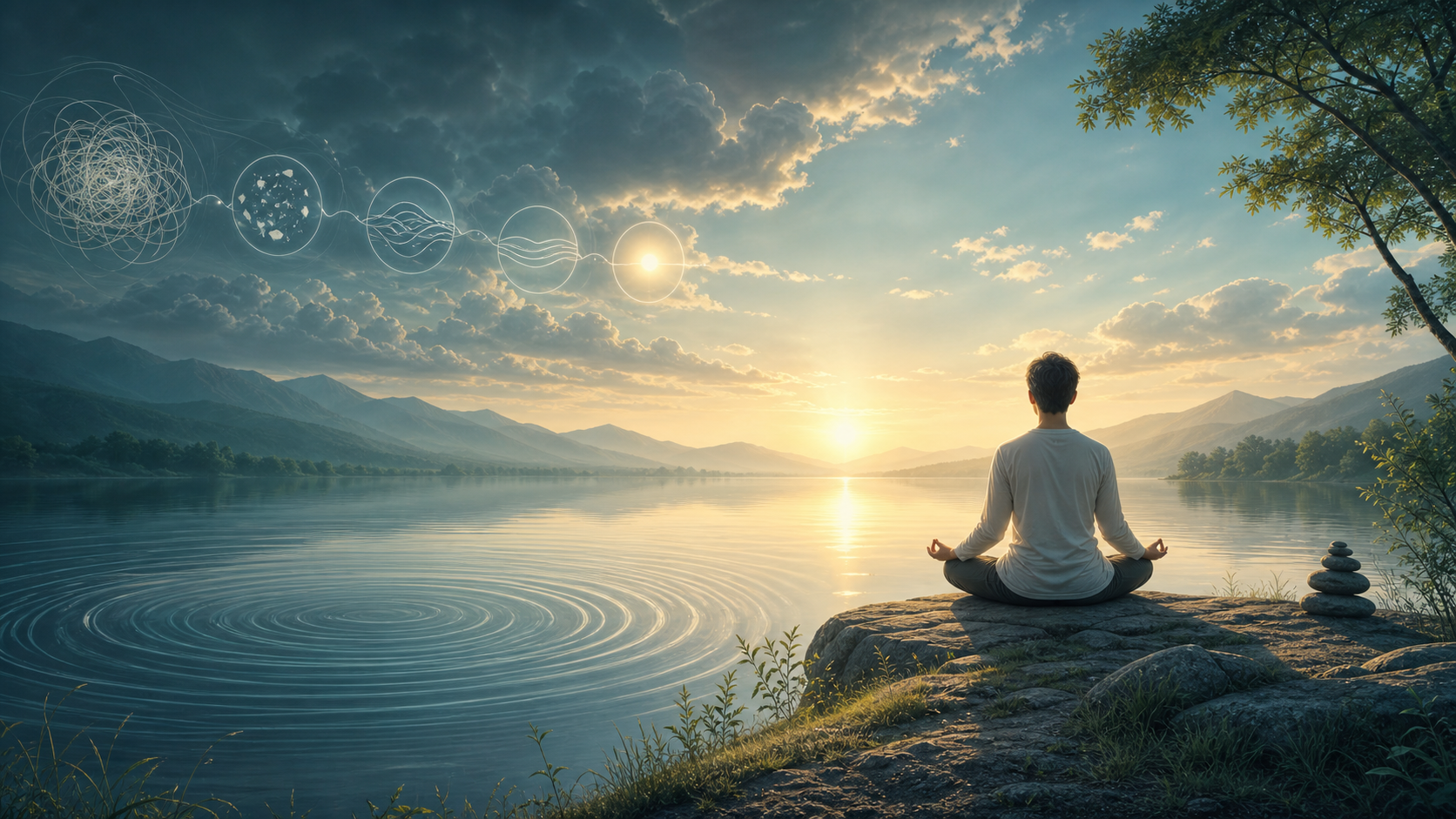
Vritti means a whirl-pool. It is a wave of thought that arises in the Antahkarana. Vrittis are modifications of the mind. They are the effect of Avidya. It includes emotions, memories and imaginations spinning around the mind especially when we try to sit for the meditation.
When vritti arise, they create a kind of ripple effect throughout the body and nervous system. When these ripples become patterns, they form ‘Samskara’ (impressions left by past experience). They form on the basis of future reactions, habits and mental fluctuations, which bind us to Karma.
There are 5 types of Vrittis –
1. Pramana (Right Knowledge) – Something we know based on fact or observation. State where mind reflects reality.
2. Viparaya (Misconception) – Misconception that leads to false conclusion.
3. Vikalpa (Imagination) – Fanciful or vague impressions. 4. Nidra (Deep Sleep) – Absence of conscious thoughts. 5. Smriti (Memory) – Recalling the past thought or event stored in our mind.
“With absolute control over body, mind and senses in every phase, a niruddha mind glides through life and divine grace.” After passing through the state of Ekagra, one is able to hold on a single point. Here, the attention is fully arrested and concentration on one point. At this stage, no old or new impressions can distract the mind from point of focus and complete stillness is reached. One is able to glide through life with utmost grace. Mind is now fully under control and all the fluctuations come under the direct control of intellect (Sattvic Buddhi) as opposed to being controlled by ego. When the yogi sustains in this state of Niruddha for a long periods, the mind reaches the state of equilibrium of trigunas which leads to liberation (Kaivalya).